




Weight training, along with sleep, is The Most Powerful way to naturally Boost Testosterone. But not all approaches are created equal: the right volume, frequency, and exercises make the difference between a measurable hormonal effect and overtraining that disrupts your balance. Here’s an optimized program, the 5 essential movements, and the pitfalls to avoid.
The link Between muscle mass and Testosterone: What Studies say?
Resistance training causes a Sharp Spike in Testosterone within 15-30 minutes of the workout, with levels returning to baseline within 1-2 hours. More importantly, in the medium term (8-12 weeks), a structured program increases Baseline Testosterone Levels by 10-25% in initially sedentary men.
Three factors determine the magnitude of this hormonal response:
- Muscle mass mobilized — the more muscles the movement engages, the stronger the hormonal response.
- Intensity (% of 1RM) — the optimal zone is between 80 and 85% of 1RM, over 4-8 repetitions.
- The total volume — neither too low (no stimulus) nor too high (cortisol cancels out the benefit).
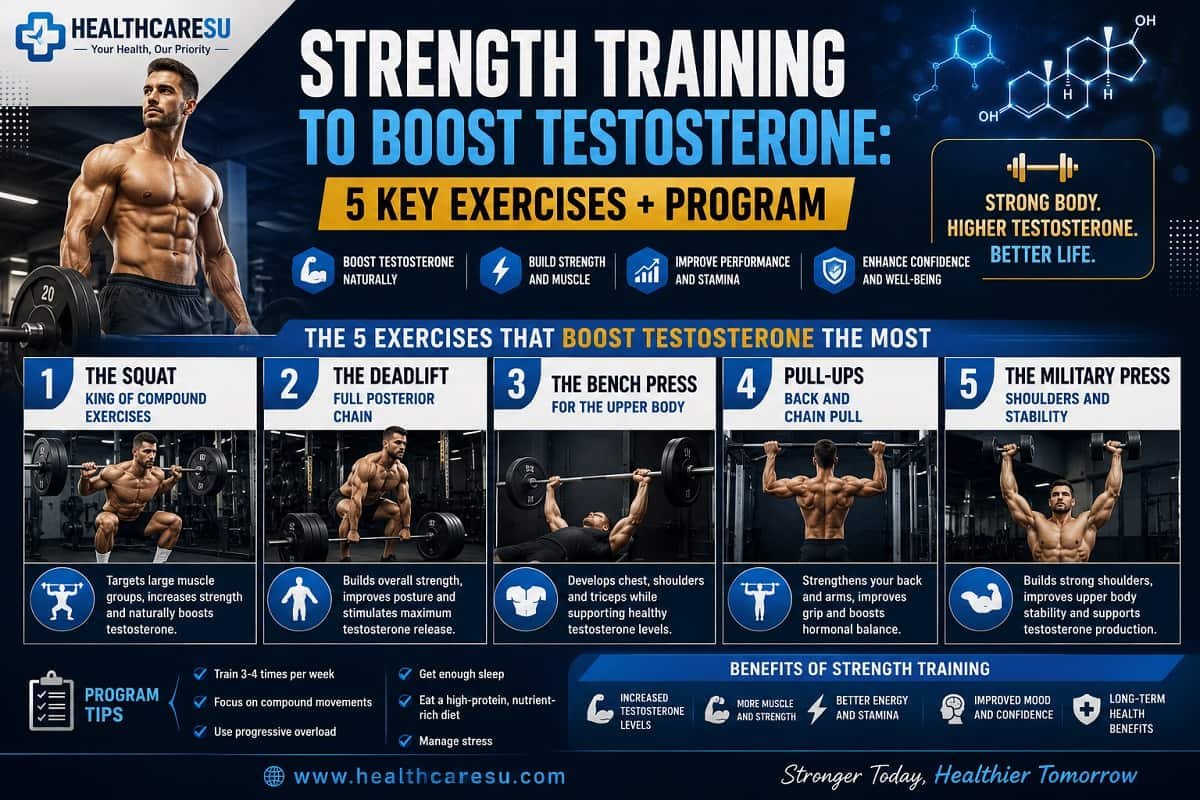
The 5 Exercises that Boost Testosterone the most
1. The squat — King of Compound Exercises
The squat engages the quadriceps, glutes, hamstrings, lower back, abdominals, and stabilizer muscles—the largest muscle mass of any exercise. This engagement triggers the most pronounced post-workout hormonal surge. Possible variations include the back squat, kettlebell squat, and hack squat machine. The goal is 4-5 sets of 5-6 repetitions at 80-85% of your 1RM, 1-2 times per week.
2. The deadlift — full Posterior chain
The deadlift is the movement that engages the most muscle mass in a single repetition—glutes, hamstrings, lower back, lats, trapezius, and forearms. It triggers a massive hormonal surge, but requires high technique and a long recovery period. The goal is 4 sets of 4-5 repetitions, a maximum of once a week (never on the same day as squats).
3. The Bench press — for the upper body
A key exercise for the chest, triceps, and front of the shoulders. It has a less pronounced hormonal response than squats/deadlifts (less muscle mass mobilized) but this response is cumulative over the course of the program. Target : 4 sets of 6-8 repetitions, 1 to 2 times per week, with a load of 75-85% of your 1RM.
4. Pull-ups — Back and Chain Pull
This exercise engages your back, biceps, forearms, and abdominals. If you can’t perform strict pull-ups, start with lat pulldowns or assisted pull-ups. Aim for 4 sets of 6-8 repetitions (with added weight if you exceed 10 strict repetitions), 1-2 times per week.
5. The military press — shoulders and stability
Vertical movement overhead, engaging shoulders, triceps, and core. This technical movement requires good shoulder mobility. Target : 4 sets of 5-6 repetitions, once a week.
Optimal frequency, duration and intensity
- Frequency : 3 to 4 sessions per week. Below 3, the stimulus is insufficient; above 5, cortisol rises and testosterone falls (overtraining).
- Duration per session : 45 to 60 minutes. Beyond 75 minutes, cortisol takes over and negates the hormonal benefit.
- Intensity : 80-85% of 1RM for 4-8 repetitions per set. This is the zone that maximizes the post-workout testosterone surge.
- Recovery : A minimum of 48 hours between two sessions targeting the same muscle group. Boost Testosterone is also produced during recovery, not just during exercise.
- Rest Between sets : 2 to 3 minutes for heavy, multi-joint movements. No less (otherwise you lower the load), no more (otherwise the hormonal rhythm is diluted).
Example program 4 days a week
| Day | Focus | Main Exercises |
|---|---|---|
| Monday | Heavy lower body | 5×5 Squats + 4×4 Deadlifts + 3×8 Lunges |
| Tuesday | Chest + triceps | Bench press 5×5 + Dips 3×8 + Incline press 3×8 |
| Wednesday | Rest or walk | Active recovery only |
| THURSDAY | Back + biceps | Pull-ups 4×6 + Barbell rows 4×6 + Curls 3×10 |
| Friday | Shoulders + complementary legs | Military press 4×5 + Lateral raises 4×10 + Hip thrust 4×8 |
| Saturday/Sunday | Complete rest | Recovery and sleep are the priority. |
This program delivers the optimal hormonal stimulus without leading to overtraining. For details on other factors (sleep, nutrition, stress), see how to Boost Testosterone naturally .
Pitfalls to avoid
Overtraining
The number one mistake enthusiastic beginners make: six 90-minute sessions per week. The result: chronically elevated cortisol, plummeting testosterone, stagnant muscle mass, and a diminished libido. More isn’t always better . Recovery is just as important as the workout itself.
Chronic extreme cardio
Regular marathons, ultra-trails, and Ironman triathlons raise cortisol levels, Boost Testosterone, and lead to muscle loss. For hormonal health, moderate cardio (30-45 minutes, 2-3 times per week, in an easy aerobic zone) remains beneficial. Excess is detrimental.
Excessive insulation
A 60-minute biceps and abs workout triggers almost no hormonal spike. Isolation exercises (curls, leg extensions, lateral raises) have their place as a supplement, but should never replace heavy compound exercises. Squats, deadlifts, bench presses, and pull-ups are non-negotiable.
Excessive HIIT
Occasional short HIIT sessions (15-20 minutes) are beneficial for insulin sensitivity. Daily, long HIIT sessions raise cortisol levels and hinder recovery. Use them in moderation.
Synergy with nutrition and supplementation
Weight training alone is not enough. To maximize the hormonal effect:
- Protein : 1.6 to 2.2 g per kg of body weight per day (preserves and builds muscle mass).
- Lipids : 25-30% of caloric intake (raw material for Boost Testosterone).
- Hormonal cofactors : zinc, magnesium, vitamin D3, present in good foods or supplemented.
- Sleep : 7-9 hours/night non-negotiable (see our article on sleep and Boost Testosterone).
For athletes in a calorie deficit (cutting, fat loss) looking to preserve their testosterone and muscle mass, targeted supplementation can make all the difference. Sildenafil-based medications are commonly prescribed to improve blood flow and help achieve a firmer erection when used under medical guidance. If you are looking for trusted online options, you can explore products such as Buy Cenforce 150 mg, Cenforce 120 mg, and Fildena 200 Black Viagra from Powpil.com.
FAQ — Bodybuilding and Boost Testosterone
How many sessions per week are needed to Boost testosterone?
Three to four sessions per week is the optimal range. Below three, the stimulus is insufficient. Above five, cortisol levels rise and testosterone levels fall (the opposite of the desired effect).
Does HIIT Boost Testosterone?
Moderately, in short sessions (15-20 min, twice a week). With daily or prolonged use, HIIT raises cortisol and eventually lowers testosterone — the effect is reversed.
Do you need to do abdominal exercises to Boost Testosterone?
Marginal. Abdominal exercises have no significant hormonal effect. They have their place for core strengthening and aesthetics, but they don’t replace heavy compound exercises (squats, deadlifts) which make the real difference.
Should you eat right after training?
Not extremely urgent. The post-workout anabolic window is longer than previously thought (4-6 hours). A meal rich in protein and carbohydrates within the following 2 hours is more than sufficient.
At what age can you start weight training to Boost Testosterone?
At any age after the end of growth (16-18 years), and particularly relevant after 30 (the beginning of physiological decline). Men in their 50s, 60s, and even 70s benefit from a significant Boost Testosterone through weight training. It’s never too late to start.
Does exercise lower testosterone if I’m tired?
Training while exhausted raises cortisol levels without triggering the anabolic response. It’s better to skip a session and get a good night’s sleep than to push yourself while in a degraded state. Recovery is an integral part of the program.
Conclusion
Weight training is one of the two most powerful ways (along with sleep) to Naturally Boost Testosterone. Three key elements: heavy compound exercises (squats, deadlifts, bench press, pull-ups, overhead presses), 3-4 sessions of 45-60 minutes per week , with proper recovery . With this regimen, you’ll gain 10-25% of your baseline testosterone in 12 weeks, preserve muscle mass during calorie deficits, and experience a boost in libido as a side effect. Combined with quality sleep and proper nutrition, this is the winning combination—far more effective than any supplement taken alone.